


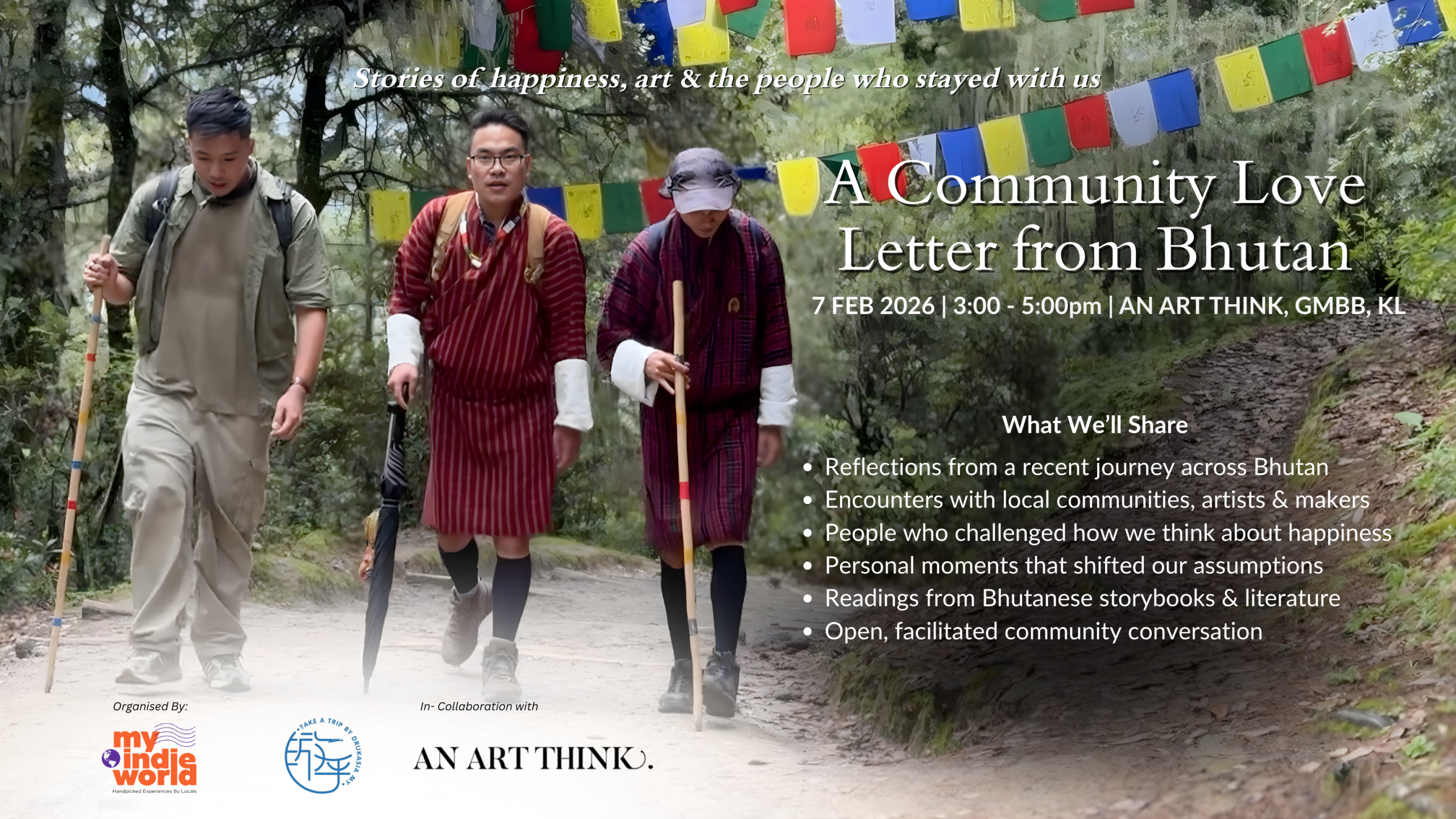


There are travel videos that tell you where to go. And then there are journeys that quietly change how you see travel itself.
This 15mins video from Bhutan belongs to the latter.
I didn’t go to Bhutan to make an art film. I didn’t set out to frame the journey around highlights or landmarks. What unfolded instead was a slower realisation — that an experience can be shared the way art is shared.
In this journey, art wasn’t a subject. It was a way of moving.
Starting With People, Not Places
Most travel stories start with places. This one began with people — artists, in particular.
They shaped how I saw Bhutan.
Bhutanese contemporary artist Pema Tshering (Tintin) articulated it simply:
“I feel like artists are more sensitive people. They are rooted in their surroundings much more than others. They notice what’s happening outside and inside at the same time.”
That sensitivity became the guiding principle of the journey. Instead of asking what we should see, we asked who we should walk with.
This shift mattered. The pace slowed. Conversations weren’t designed for content. Moments weren’t rushed to become highlights. Bhutan wasn’t explained to us — it revealed itself through lived experience.
Rather than moving through Bhutan, we moved alongside people deeply rooted in it.
Culture That Doesn’t Need to Perform
One of the strongest impressions from the journey was how culture exists in Bhutan — not as something staged for visitors, but as something lived.
There was music, performance, conversation, and silence. None of it felt curated for an audience. Creativity surfaced naturally, without needing to justify itself.

Bhutanese actor, singer-songwriter, and theatre artist Tshering Dorji reflected:
“Visitors don’t leave Bhutan with souvenirs of power or wealth. They leave with a quiet shift inside — a heightened awareness of themselves and their surroundings.”
That quiet shift is difficult to document. But it’s unmistakable when it happens.
I remember the moment when a song was shared — deeply personal, offered without explanation. My travel companion, Gigi, teared up almost immediately. She didn’t understand every word, but she understood the feeling.
Art, in that moment, wasn’t entertainment.
It became a bridge — connecting people without asking them to decode anything or everything.
Hospitality as a Way of Living
Hospitality in Bhutan often grows from personal history rather than business logic. And one story, in particular, stayed with me.
I have known the COMO brand for years. But hearing Tshering’s story gave that name a different weight. He grew up close to the land — his parents were farmers who supplied produce to COMO — and he himself spent his early years working in the kitchens at Uma by COMO, moving through stewarding, food production, and the discipline of service long before he ever ran his own place.
Today, at Rema Resort, that early grounding shows up clearly. Food, land, and people are treated as one system. Sustainability, for him, was never about trends or positioning.

As Tshering puts it:
“Being sustainable doesn’t only mean going green. I just want to make sure I’m able to support people in correcting what they have done wrong before.”
That belief carries through in how he runs Rema — building slowly, sourcing carefully, and often giving people second chances and space to rebuild. It’s not something he explains often. It’s simply how the business is lived.
Hospitality, here, becomes a creative act — not in aesthetics, but in care.
Rewriting What It Means to Travel
Another perspective strengthened how I think about travel today — especially in a time when so much of it is shaped by screens, algorithms, and the people who guide us through places we’ve never been.
Bhutan’s first solo female travel blogger and author of The Tourist Within spoke openly about choosing honesty over polish.
“My specialty is being very raw and unapologetically myself.”
Her philosophy on hosting is equally direct:
“I don’t treat tourists like tourists. I treat them like my friends.
The moment you start treating someone like a guest, the essence of being together just dissolves.”
The distinction matters. The moment someone becomes a “guest,” distance forms. Roles appear. Hierarchies settle in. But when people are treated as equals, something else happens — conversations open up, trust forms, and travel becomes relational rather than transactional.
Content may move people to a destination. But it’s real human connection that moves something inward.
A guide who treats you like a friend. A storyteller who shows the unpolished, everyday side of a place.
That’s when travel stops being about where you’ve been — and starts shaping how you see the world, and yourself.
Staying as a Choice
Before this journey, I carried the familiar idea of Bhutan as a place that had “figured out happiness.” That assumption didn’t hold.
Bhutan isn’t frozen in time. It is connected to the wider world — its opportunities, pressures, and contradictions. People leave. People return. Choices are negotiated.
What gave this journey weight was meeting people who chose to stay.

My guide, Karma, shared his decision plainly:
“Our King asked, ‘Will you be with me?’ The second time, he asked again. Everyone said yes. And I took a vow.”
He cancelled plans to live abroad.
“Now I’m still here in Bhutan.”
Staying, in this context, wasn’t about resisting change. It was about commitment — carrying stories forward, knowing which moments deserve to be loud, and which should remain quiet.
Where Their Roots Quietly Begin
As the journey unfolded, a pattern emerged.
Different artists. Different disciplines. Different stages of recognition. Yet many shared the same starting point.
Whether it was Tintin, Moksh, Barun, or Sonam — VAST wasn’t simply where they learned to create. It was where curiosity was given room to grow, without pressure to perform or arrive at answers too quickly.
Sonam spoke about arriving at VAST during a formative stage of her life. What she found there wasn’t instruction in the traditional sense, but grounding — a space that encouraged reflection over output, attentiveness over speed.
Founded in 1998 by artist Asha Kama and a group of peers, VAST began as a non-profit with a simple but ambitious intention: to open up new ways of seeing and creating, while remaining deeply connected to Bhutan’s social, cultural, and environmental realities. Over time, it became less about producing artists, and more about shaping how young people relate to the world around them.
VAST didn’t teach artists how to scale. It taught them how to stay — connected to land, people, and themselves.
In a travel world obsessed with momentum, that kind of grounding feels quietly radical.
What Remains After the Journey
This film doesn’t try to define Bhutan. It doesn’t offer a formula for happiness.
Instead, it leaves a quieter question behind:
What happens when we stop trying to extract meaning from travel — and allow meaning to surface on its own?
Perhaps happiness isn’t something to be found.
Perhaps it begins when people open their lives as they are, and invite others to slow down long enough to notice.
That, in many ways, is the true art of travel.
How to Watch This Film
Watch it slowly. Let the pauses sit. Notice the relationships more than the scenery. You don’t need to understand everything immediately.
You’re not meant to.

